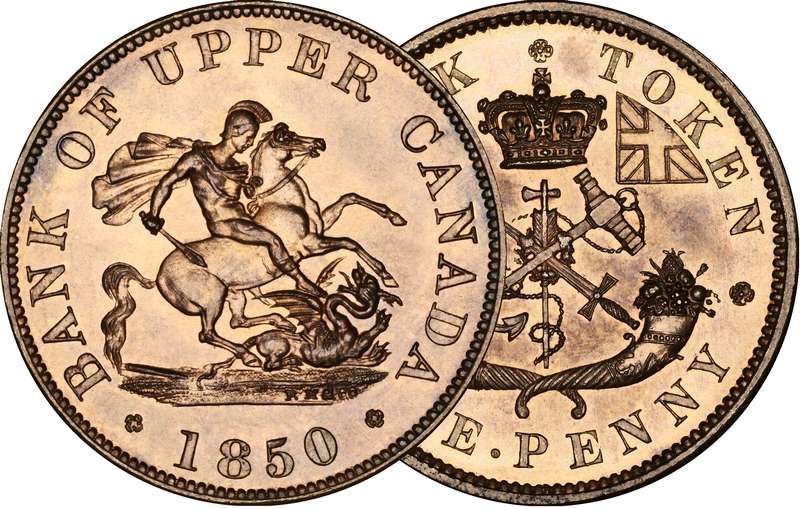
Bank Of Upper Canada 1850 Penny
Start Page
Lorem ipsum dolor sit amet, consectetur adipisicing elit. Repudiandae odit iste exercitationem praesentium deleniti nostrum laborum rem id nihil tempora. Adipisci ea commodi unde nam placeat cupiditate quasi a ducimus rem consequuntur ex eligendi minima voluptatem assumenda voluptas quidem sit maiores odio velit voluptate. Lorem ipsum dolor sit amet, consectetur adipisicing elit. Repudiandae odit iste exercitationem praesentium deleniti nostrum laborum rem id nihil tempora. Adipisci ea commodi unde nam placeat cupiditate quasi a ducimus rem consequuntur ex eligendi minima voluptatem assumenda voluptas quidem sit maiores odio velit voluptate.
Introduction To Identifying The 1850 Penny
In identifying which die pair your 1850 Bank of Upper Canada penny represents it is best to use a methodical, stepwise approach. In this catalog we offer three methods of identification: Quick Search by Die Cracks, Quick Search by Die-Defining Markers, and the Die Pair Tree. Inability to identify the die pair (and hence catalog number) of your token sends you from one method to the next. You should begin with either Quick Search by Die Cracks or Quick Search by Die-Defining Markers. If your token lacks die cracks or other strong die markers, then proceed to the Die Pair Tree.
Method #1
Quick Search by Die Cracks
The first approach in identifying your token’s die pair is to check for die cracks. Many dies eventually cracked and these cracks can be very useful for die-identification purposes. Die cracks are like fingerprints; no two are exactly the same, even if they are pointing to the same letter or digit. So, in that sense die cracks can be said to be die-defining. If you’re lucky enough to find one or more die cracks on your token you’ll likely be able to identify the die pair very quickly. Finally, some die cracks are small and easily missed. Missing a crack is not a problem in the identification process, because your die pair would likely be identified in one of the other search methods anyway

Method #2
Quick Search by Die Pair-Defining Markers
In the description of Method #1 we noted that die cracks are die-defining. However, there are other non-die crack features that can be die-defining. These include repunched digits/letters with a strong offset, letters with broken serifs, and major die gouges. If a token has one or both dies with strong non-crack markers, they can be used to quickly define the die pair. For the 1850 penny some 15 of the 36 die pairs can be identified in this way. Photos of the markers, along with the die-pair number from which they came, will be displayed for you to compare with your token.

Method #3
The Die Pair Tree
The Die Pair Tree is the slowest method of die pair identification because it has the most steps. However, it can be extremely useful in ferreting out even the hardest-to-identify die pairs. In this sorting process, you are presented with a set of stepwise decisions. You are directed to each successive decision based on the results of the last decision. Note that the 15 die pairs covered in Method #2 (Quick Search by Die-Defining Markers) are not included in the Die Pair Tree, so before using the Die Pair Tree make sure to first check your token via Method #2.